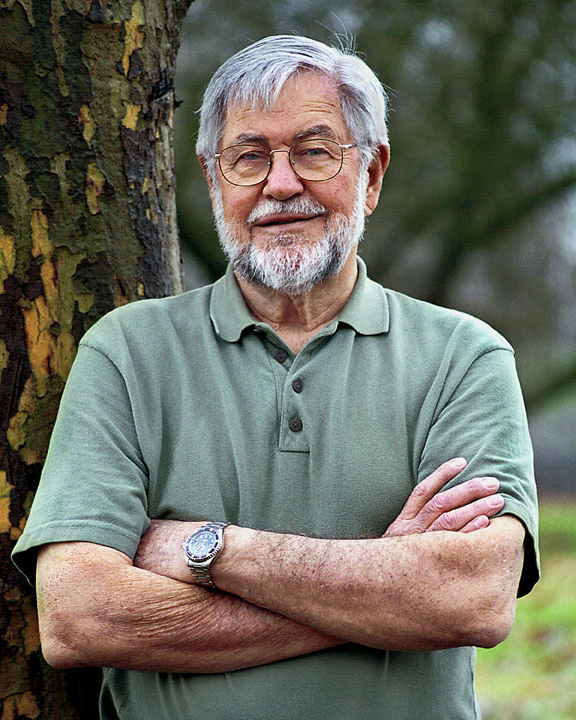
CHUCK'S THOUGHTS ON
PHOTOGRAPHY
The basic problem of creating a photograph is no different
from that faced by the masters of the Renaissance. That
problem is how best to represent a three-dimensional world
in two dimensions. The camera is just a tool to help do that
(Some of the masters actually used a camera. Since they had
no film, they simply sat inside their cameras and sketched
the inverted scene projected on the back wall. Look up
camera obscura; literature from as far back as 400 BC
describes it. Leonardo da Vinci wrote a treatise on
it. [If the Mona Lisa was a photography competition
entry, I might have counseled him as follows.]
Leonardo, you have a very attractive model here. You seem to
have a “feel” for this kind of portrait. However, there are
several improvements which you can make. The light area at
the top draws one’s eyes away from the center of interest –
so would suggest burning it in, particularly the corners.
The background is too “busy” and therefore also deistractrs
fron the center of interest. Next tine use a plain
background.
Mona seems to have no eyebrows and her lips are very pale. I
suggest you be certain that she use sufficient make-up the
next time. Marshall oils will fix up this print. You need a
fill light head-high and to the right as the shadow is too
dark under the chin. As a result, you have lost all detail.
I find my eyes jumping from the face to the hands. The print
would be considerably improved by burning in the hands and
forearms. On second thought, it would probably be better if
3-1/8 inches were cropped from the bottom and 1-1-3/16
inches were cropped from the right.
Leonardo, again I say you have found a good model, and
I’d try to get her to pose again – and to pose without
that silly grin. You can do much better work than this. |
CHUCK'S PHOTOGRAPHY
EXPERIENCE
In 19391 developed my first role of film in my mom's back
porch laundry trays working at night under a little red
light bulb. Using the same little red light, I sandwiched
the negative and a sheet of contact paper in a contact print
frame. After exposing this to a 60-watt bulb while counting
out the seconds of exposure, I developed the print in a dish
of developer and was fascinated with the magic of the image
appearing.
We lived in a rural area, so I ordered my photography
supplies from the Scars and Roebuck Catalog. A couple of
years later my dad and I made an enlarger from scratch, even
folded the leather bellows ourselves.
In the fifties and sixties I used Rolleis, Speed Graphics,
and various rail cameras. I worked with various developers,
films, and photo papers to control the tonality of my prints
(sort of a variation of Ansel Adams's zone system). In the
early seventies I added a 35 mm single lens reflex and
started shooting color slides. My favorite film camera,
though, was the Mamiya RB67 with its revolving back and
interchangeable lenses.
Over the years my darkrooms grew more and more sophisticated
and my prints ot bigger and bigger
Now 1 am totally sold on digital photography. I switched
from the darkroom to digital printing about twelve years
ago. I started with the first version of Photoshop that
became available and have worked with each of the ten
upgrades. In the last four or five years I have been
shooting nothing but digital cameras.
Digital is not necessarily superior to film, but it does
have lots of advantages. What 1 like is the ability to
experiment without wasting film.
Occasionally I take on a paying job just to help offset the
cost of my photographic equipment and materials. But rather
than make pictures to please a client, I’d rather make
pictures for myself.
As you will see from the images on exhibit, I’ve never
adopted a particular photographic style or concentrated on
a particular subject matter. I photograph anything and
everything: people, sporting events, animals, rocks,
smoke, soap film, buildings, reflections in crumpled
mylar, machinery, junk, etc., etc. If I had to pick a
favorite subject, I guess I’d have to say it’s people.
People are fun to photograph when they are performing (on
stage so to speak). At renaissance fairs, parades, folk
dances, jazz festivals, cultural fairs, and such
participants are eager to be photographed and are very
cooperative.
I love to rework my images in Photoshop and turn them
into something other than plain photographs.
After we got our kids through college, Jane and I started
traveling. And I always had a camera along. During the 80’s
and 90’s we traveled by bicycle because we like cycling and
we found that being on a bicycle resulted in intimate
closeness to the country and the people. We would find
fascinating places off the beaten track that tourists don’t
usually see. On our first trip in France we stumbled on the
wonderful medieval towns of Vitre and Fougeres. On a second
trip we found the fabulous ruins of a Benedictine abby at
Jumiéges. |